
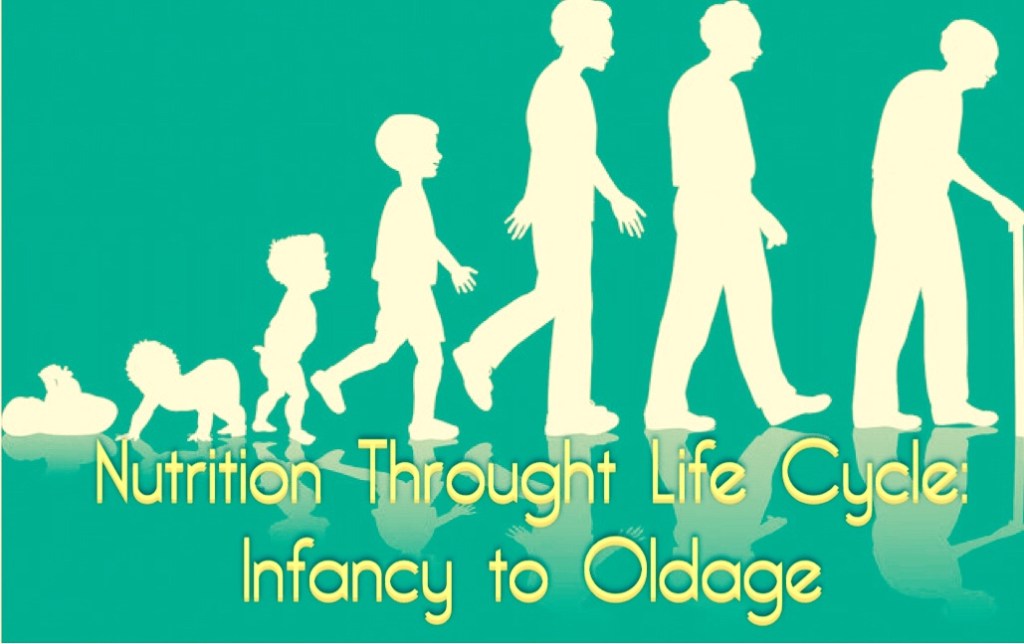
The momentous of good nutrition is very eminent, the way we undeniably put down the efforts to unify the diversity of healthy foods to our family members platters from the neonate to dotage is admirable. But somewhere there is a dismay which stimulates the nerve-racking questionnaire in mind that why my child is not eating properly or growing up or having poor appetite or why am I suffering with lot of diseases, what should I eat or not at this age … and this never ceases.
My friends the interpretation to above niggling thought is our obliviousness that, “nutritional needs of our body vary throughout the life cycle which is actually based on the growth and development that takes place in our body”. You have noticed that the nutritional needs of an infant & children are totally different from that of adults and which further anew when grandpa is going to gash his 60th birthday cake. But we barely use our intelligence to realise this fact.
Understand the young people from infancy through adolescence are growing in terms of increasing in size of the body as well as development and maturation of the organs & systems (Brain, kidney, liver, hormonal glands etc) that takes place internally which is a characteristic that we adults do not share because the whole development and growth in us have been consummate up till now and so with this our requirements for nutrients also changes which is only for the maintenance of body, better immune system, support pregnancy/ lactation.
But we are jammed with the confusions about all we read and hear. Most people are left in a state of indecision about the terminology to achieve optimal health. It seems the more we read, the more uncertainty we experience. So ladies and gentlemen let’s end this bewilderment by acknowledging the nutritional requirements through out the life span from infancy to old age.
Stage1: The Boss Baby
- Infancy is the critical period of development which lays the foundation for future growth of a child because all round growth and development of baby is very rapid during this first year of life.
- This period is full of transitions as your baby now comes from the safe protected environment (mothers womb) into an environment which places a lot of stresses on it and now baby has to make an effort to get the food it needs and has to deal with infections.
- Put the baby on breastfeed within an hour of birth because the nutritious colostrum which is your baby’s first food is full of protein, antioxidants, a natural laxative, regulates body, antibodies etc. So breastfeeding is unique, easily digested, full of nutrients and protects baby from many infections, allergies during this vulnerable period.
- It is advisable that after 6 months along with Breastfeed add some complementary foods to yours baby diet in small quantities which are gradually increased with pace- like- 6-8 months feed 2-3 times, 9-11 months feed 3-4 times, 12-24 months feed with an additional nutritious snack.
- Foods like, Cereals (rice/ chappati soaked and mashed in milk/ curd/ dhal), fruits (mashed -banana/ mango/ papaya/cooked apple). By the 7th or 8th month soft cooked dals, khichadi, Pongal etc properly mashed can be given to them. Egg yolk can also be given but egg white should be given only by the end of first year.
Stage 2 : The Mighty Bheem and Chutki
- After twelve months to 6 years, these babies now called as toddlers which now can crawl or walk and talk and also run and play. This is the age which forms the foundation for a lifetime of good nutrition and health practices. Not only this their brain thoroughly develops during this stage so they tend to behave like Sherlock Holmes.
- They are very active and try to become selfless by eating their own meal ; why not they want equal share in every terms like the adult members do. So by the one and half years your child should be eating the same food as the rest of family but care should be taken that it shouldn’t be too spicy because their digestive tract cannot take that spicy and oily foods so their nourishment should come from solid foods.
- During second and third years, toddlers need less food than we expect and mothers get worried by thinking, it is a poor appetite but note that preschoolers don’t grow very rapidly as they did during infancy.
- They also have some health problems and are more susceptible to infections like, diarrhoea, fever, measles, dysentery etc but there is no need to worry, this is quite obvious because now the child’s milk intake from mother (breastfeed) may gradually decrease and the protection it receives also lessens, so their body is taking some time to build up its defence system.
- Let your child to try all kinds of vegetables and fruits by making them more appealing don’t transmit your likes and dislikes on them, most importantly never use food as a bribe for good behaviour or punish them by not giving them especially the food they like.
- So it’s necessary to feed your child with a balanced meal from all food groups, (chappati, eggs, rice, milk, dhal, fruits, curd, papad, all seasonal veggies (specifically put the new ways to feed them with green veggies, orange/ yellow fruits and veggies as these are the protective food groups which prevent them from infections, diseases).
Stage 3 : The Dexter and Dee Dee
- This age also called as middle childhood which begins from 6 years up to 12 years and they are bounded by daily routine of school and extra curricular activities. In this period there is a steady increase in their height (5to 6 cm approx.) and weight (2 to 3 kg/year) with little growth in head size with trunk and legs growth.
- Children’s of this age are more resistance to disease than preschoolers. Not only this, the end of this period varies between the sexes and between children, so one thing is necessarily to be kept in mind that the girls should have an adequate iron intake so they have sufficient storage before they reach menarche.
- The child has a poor appetite like preschoolers but on the whole however the child will be eating more amount of food and in most cases accept all wider dishes. Likes and dislikes have been established but they might not be permanent.
- Your child is spending more time in school so there meal timings should be adjusted according to their schedule. Care should be taken that child should have good breakfast, include not only cereal but also protein rich foods and fruits which supply vitamin C.
- In daily diet in addition to an adequate intake of cereals include at least 2 serving of fruits, vegetables ( including 1 green leafy/ yellow/orange), 2 servings of dhal, milk (400ml) etc.
Stage 4: The Johnny Bravo
- This age called as Adolescence or teenage which begins from 12 upto 19 which is a unique period of dynamic change which may be referred as growing age, where not only a boy or girl attain physiological maturity but the adolescent also becomes increasingly independent and tries to be adult. Note no other group is as concerned about their bodies or is as sensitive and hurt by criticism as in an adolescent.
- At the end of adolescence the individual has functional reproductive organs and has attained final physical growth. The velocity of physical growth in adolescence is second only to the growth rate during infancy.
- So when you feed these over figure conscious group, remember that food and nutrients needs are going to be higher during the growth spurt (so include calorie and protein rich foods) but energy requirements will depend on the amount of activity they are involved in.
- Include a well balanced meals with all form of cereals, pulses ( 2..5-3 servings), milk, dairy products, fruits (2-3), green leafy veggies (1), roots and tubers( 1.5-2), other vegetables (2) etc these foods provide them essential minerals- calcium ( for increased skeletal mass), iron ( for expansion of blood volume), zinc ( for development of sexual organs, generation of new skeletal and muscular tissues) etc and vitamins- A, B- complex, C etc.
Stage 5: The Flinstones
- The period of this stage begins from 25 years upto 60 years and more often called as adulthood. So the main concern of this age group is to maintain their body in good health, to counter the physiological alterations in metabolism like pregnancy and lactation that do increase nutritional requirements, to prevent the development of diseases – heart diseases, diabetes, obesity, hypertension, hormonal changes etc.
- Age, occupation and level of activity can determine the nutrients needs of an adult. Always eat in accordance with your energy expenditure so that you don’t put on weight, so we should eat mindfully because many people complain of heartburn, constipation, lack of vitality, fatigue etc because we eat more than our requirements and do not exercise or stay physically active as we used to be in childhood.
- Include a well balanced meal with all food groups ( mentioned in my previous blog “ Food: Lets Revamp its Understanding)- cereals, millets, seasonal and local fruits, pulses, green vegetables, tubers, orange/yellow (100g) at least 2-3 in a week, dairy products, milk (100ml- 3 servings), fats/oil (5g- 3 to 4 servings) etc, through this our body gets essential amino acids, complex carbs, good fats, essential vitamins, minerals which help both male and females in achieving good health.
Stage 6: The Muriel and Eustace Bagge
- This stage is called as old age where there are changes in appearance, mental outlook and body functions of people as they move from adulthood to middle age and then to old age. As we grow older our body is the sum total of care, use, misuse or neglect it has undergone.
- This age undergoes with considerable changes for eg- some lose their teeth, digestive issues, Osteoporosis, loss of memory, anaemia, weaken immune system so they are more prone to infections etc, this is so as we get up in years the body renew less cells and tissues. So we need less energy to keep it going and this can be achieved by proper meal planning so we get all forms of nutrients.
- Be sure to include foods from all the groups in minimum number of servings of each in order to maintain normal body weight, pressure cook there foods to ensure soft texture. Some special needs for calcium, iron, iodine with generous amount of vitamins, (especially vitamins C & E- antioxidants) from fruits, veggies is to be taken which reduces the risk of cancer, cataracts , heart diseases etc. Those who are lactose tolerant can include ragi, almonds, tofu, soaked figs, apricots, raisins, til etc to meet calcium needs.
- The need for nutrients in this age is not altered but utmost care is to be taken that while selecting foods to meet energy needs, it is advisable to reduce (not eliminate) the animal fat as these are linked with higher rate of atherosclerosis. Better include good fats vegetable oils ( groundnut, til, coconut) moderately.
Thus the basic principle of nutrition remains same throughout the life cycle what matters is the proportion, essential requirement of certain nutrients and the mindfulness approach while selecting and gushing them according to ones need.
 Healthy Talks
Very nice & informative quotes.👍
LikeLike
Thanks a lot dad❤️❤️
LikeLike